
Land of the Firefox - An expedition into the Eastern Himalaya


Singalila National Park and Nepal forests – the area explored for Red Pandas
With an estimated global population of less than 4000 individuals, a number which is highly questionable because of the lack of extensive studies across their habitat, the Red Panda or the ‘Himalayan Firefox’ is one of the most secretive, poorly understood and vulnerable animals of the Himalaya.
The Red Panda’s range extends through dense broadleaf, pine and bamboo forests of the Himalaya, a high biodiversity habitat that exists in mountain slopes between roughly 8000 and 12000 feet. Populations have been found in such habitats across Nepal, the states of Sikkim, West Bengal and Arunachal within India, northern Myanmar and in the extreme east of their range, along the Yunan and Sichuan provinces of China.

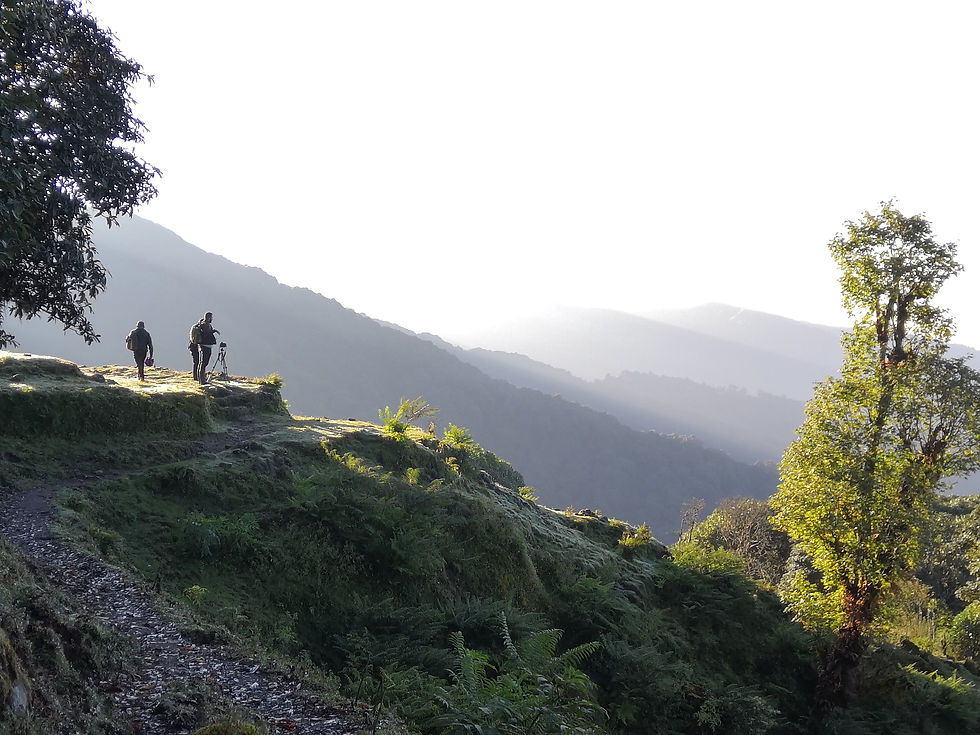
broad leaved forests of oak and cedar dotted with bamboo – ideal Red Panda habitat
Singalila National Park, a few ridges away from Darjeeling, the tea capital of the world, is nestled in the Mahabharat range of the Indian Himalaya. It is bordered by Tinchule, Kalapokari and Jhaubari forests of Nepal to the east. The road to Sandakhpu, the highest point in the landscape, winds along the border with Indian forests to the right and Nepali hamlets on the left located among few dense remnant forests.

Sections of this road are non-existent and so steep that only the modified 1950 Landrovers, owned by a few locals, navigate this stretch. The remote Nepali villages along the border depend on these drivers for supplies and also for transporting people.

In recent times, the Landrovers are hired by avid hikers who wish to reach Sandhakpu for the spectacular Himalayan views.
Studies on the Red Panda were carried out in these forests in the nineties, both on the Indian and Nepali side, including the first ever release and monitoring of zoo bred Pandas into the wild. Recent surveys, based on direct viewing of animals and scat samples estimate that around 40 animals roam these forests.
The village of Kayankatta rests on a ridge, at an altitude of 10000 feet with the valley of Garibas to the south and the high ridges of Kalapokhari to the north.

Kayankatta, with just two houses, is one of the smallest vilages in Nepal
The village can be accessed by a two to three day walk along the border road or by a bone shattering two hour drive. In recent years the villagers have started two homestays and have enthusiastic trackers that are climbing the slopes and descending into the valleys every day to document the habitat and the Red Pandas that call these forests home. This team is also working with villages on the Nepal side to sensitize the locals towards the Panda, the importance of its habitat and eventually make the area a community reserve where everyone conserves this ‘red raccoon’ and its forests and also benefit from this in the long run.
A hot cup of chai and introductions later, we took one of the trails into the forest hoping to catch views of the local birdlife, something the eastern Himalaya is known for world over. The twittering White-browed Fulvettas were the first to greet us as they moved low amongst the undergrowth, showing themselves only as they moved between young clumps of rhododendron. This was followed by the loud calls of laughingthrushes along a steep forest precipice. We got glimpses of the black-faced laughingthrush, moving in jerks through the undergrowth, a flock of six, but only one paused long enough for us to get a good view of the unmistakable black and white facial markings and the colourful plumage.

Just as things were getting better with a mixed flocks of hoary-throated barwings, grey-crested tits, coal tits and a lone ashy-throated warbler, a wall of mist moved in (was it the cloud - we weren’t sure) and that ended our evening. We returned to base to take in a spectacular sun show over the clouds after which a cloak of darkness took over the landscape, the stillness broken only by the crackling of the wood fire and the occasional hoot of the Himalayan Wood Owl.

We woke up to hot chai as is the ritual and setup in one of the verandahs to catch the morning symphony of this habitat.

The Swarovski ATX 95 has helped me a lot in desert and marsh landscapes before. It was as effective on the Kayankatta ridge to seek out sunning birds in the forests below, some of them as far as the opposite slope
As the sun was still trying to get over the Himalayan ridge, we could hear the birds wake up almost everywhere. It was our first morning in this landscape and the variety of the bird calls was daunting at first. But then as the light moved in, we were able to see them better which made it a whole lot easier to locate and identify the species. Yellow-billed blue magpies and large-billed crows were the most numerous and bold (or so it seemed) as they fly all around the village, cackling loudly from prominent perches. They were soon joined in by the large-spotted nutcracker. A flock of altai accentors shot past followed shortly by a large flock of rosefinches which were too quick for us to be able identify the species out of the many that occur in this landscape. A lone white-collared blackbird perched on a fence post, waiting patiently for the warmth.
White collared blackbird and yellow-billed blue magpie seen around the village
The birds of the undergrowth were difficult to spot from our perch so we walked a game trail bordered by bamboo and rhododendron on either side. The sound of the collared owlet and the great barbet, seemed to echo around us throughout the duration of the trail. The spotted laughingthrush, was the first one to be heard but the last one to show up. Stripe-throated scimitar babblers moved through the dense undergrowth followed closely by chestnut-crowned and black-faced laughingthrushes and a single blue whistling thrush. A bright emerald green flash and a quick response later, my binoculars focused on the fire-tailed myzornis, a bird I had dreams about throughout my time in the world of birding.
Spotted laughingthrush, fire-tailed myzornis, great barbet, blue-whistling thrush and chestnut-crowned laughingthrush
As the trail led lower down into the valley, we reached dense bamboo thickets. The new microhabitat unleashed on us a whole new pattern of feathers with most of them being small skulkers like the rufous-throated wren babbler, a lone chestnut-headed tesia, mixed flocks of parrotbills, rufous-fronted babblers, golden-breasted fulvettas and many more brightly patterned jewels of this wonderful habitat. The Yuhinas, Tits and the rufous sibia were surely the easiest to keep track of as they moved through mid-canopy.
As we returned back to camp, still excited about our unbelievable morning, we paused at shoulder of a hill to catch our breath. A few seconds later, two furry yellow creatures bounded across the path. One of them paused long enough to give us enough time to capture an image of the first mammal we encountered on this journey. The yellow-throated martens are widespread throughout the Himalaya and are known for their aggressive behaviour and their ability to bring down prey both on trees and on the ground, sometimes creatures much bigger too.

These martens, along with clouded leopards and common leopards roam these forests and are the primary predators for the red pandas. The mammal diversity of these forests is quite high but the visibility is very poor making it hard to see them. The orange-bellied Himalayan squirrel and the Himalayan striped squirrel were also seen by us on the trail. Rarities like the golden cat, leopard cat, clouded leopard, black bear, weasels, serow, muntjac and many others eluded us throughout the journey, though a few signs of their activity were seen. Most others were nocturnal like the masked civet, Bhutan giant flying squirrel and cats, making it even harder. The trackers also spoke of a smaller bear species that lives only on trees – we were left speculating the chances of a Malayan sun bear straying into these parts.
On our return to camp, we were served hot breakfast and a short while later, our trackers returned from the forest too to join us. The red pandas remained elusive. According to them, the recent bout of snowfall seemed to have lowered panda activity or worse, forced them to shift to other parts of the forest. We were left a little upset but discussing our morning’s findings with the rest of the village, quickly brought ours spirits back.
As the day got warmer, Himalayan griffon vultures, steppe eagles and a goshawk were seen soaring around the ridge. The trackers had melted back into the forest to look for the orange patch amongst green. They had told us that pandas are active through the day and night, feeding every few hours, quenching their thirst and returning back to the canopy to sleep. Depending on the season the diet could include fruit, buds, some leaves and occasionally eggs and even meat at times in the form of a small bird or nestling. Bamboo formed a large part of their diet throughout the year. Their stomach and mouth were designed specially to help pandas digest this leaf and the cellulose content that it brought along. These unique characters classified pandas under a separate monotypic genus, Ailurus. The genus had only one species under it until recently, when researchers split the panda populations into two separate species, the details of which remain unclear to me at the moment.
The rest of the day grew quiet with the intense sun burning the any bit of exposed skin and the birds retreated back into the denser bits. We did take a few other trails hoping to find something exciting ourselves but except for the rufous-bellied woodpecker, a nutcracker feeding on the ground and a quick viewing of a Mrs.Gould’s sunbird, the rest of the time was spent admiring flora, the ferns, orchids, daphne, the moss covered oaks and myriad others which needed the expertise of a botanist.
Rufous-bellied woodpecker, Mrs.Gould’s sunbird , Bar-throated siva and other birds

The spotted nutcracker is often seen among the canopy and seldom when feeding on the forest floor
The rest of the day and the whole of the next day were mist covered with almost zero visibility. These conditions were our biggest fear in this landscape. We had kept extra days in hand only to make up for adverse weather. The days were cold and windy and we had to restrict ourselves to short walks where only larger shapes of the occasional magpie and crow were obvious through the mist. We had to content ourselves with more engaging and interesting conversations with the locals where stories of pandas, bears and leopards came out, all of which we seemed to have missed by a few days.
The highlight of the day came right before dinner. We were served large bamboo jugs of the local millet beer, Tonba. Hot water was poured over a concoction of fermented grain and left to rest before it was sucked out by us using a bamboo straw. It was a surprisingly smooth drink and the hot temperature of it kept us warm in these adverse conditions. Just before I climbed into bed, I thought I saw a single star in the sky, maybe a bit of hope for tomorrow.
As luck would have it, we woke up to a bright sunny morning. The trackers had left early to make sure they make the most of the weather. It was a good day to find pandas, told one of them, who joined us for the hot morning brew. We had just placed our cameras and optic gear in the common area and were ready to dig into our breakfast eggs.
Just then we got news, a panda had been seen by one of the spotters. Everything after that was a big blur of excitement, bamboo undergrowth, slushy forest slopes, a few falls and finally we arrived. The tracker, JB, pointed to a large oak tree where the panda was sleeping. I quickly setup my scope in that direction and rested only when I had a large chunk of red in my frame.

Our first view of the Red Panda
It was just amazing, we couldn’t see only a part of the body, lit perfectly by the Himalayan sun. It was beautiful. The ATX brought out the detail in every hair strand of the panda. We couldn’t get any closer as the precipice was too steep so we had to content ourselves with views from the scope and a few digiscoped images. It was going to be a few hours before the panda got active again. We decided to leave and may be come back to the spot later, hoping that the panda hadn’t slipped away. We had no idea what was to come…
On our walk back, we got another call about a large female in the area, she was active and feeding on bamboo. We decided to head there immediately though it involved another long walk. We were so focused on where we were placing our foot that when we eventually reached the spot, the tracker had to stop us and point to a nearby tree. And there she was…
Our time spent with this female at close quarters as she fed among the bamboo
She was right there, moving between branches, keeping a close eye on us, stopping to grab bamboo with her dark paws and feed in a very primate-like manner. I clicked a few images and spent the rest of the time watching her with my binoculars, despite the fact that she was very close. The details of her ears, eyes, the raccoon-like face, the red fur and the white infused facial hair were brought out in great detail by my Swarovski pair. We spent close to 20 minutes with her and then decided to leave her in piece. We returned satisfied and overjoyed to a cold breakfast that lay there untouched.
The next day was clear again and we spent the time birding as usual. On one of these walks we spotted a panda. It was the most satisfying few minutes as it sunk in that we managed to find one on our own. This one was a larger individual who had a very different facial pattern. We sat just off the path on a large tree, scratching himself and licking his paws. It was just us and him. It was beautiful to watch him move through the canopy, transforming effortlessly between a dark hazy shadow and a glowing flame of an animal as soon as he stepped into the sun. It was the perfect finale for our expedition.
The individual we spotted on our birding walk – notice the bright facial markings
On our last day, we decided to visit the higher reaches of the region, especially Sandhakpu, to catch a glimpse of the famed Himalayan views and also if lucky, the blood pheasants, the various finches and the red-crossbill that is often seen in the surrounds of this hamlet. To reach the spot we had to climb a steep road with the Land Rovers. The windy road ran through tracks of beautiful forests but we couldn’t stop owing to the steep incline and the loss of momentum. Golden eagles, ravens and a dark raptor, possible mountain hawk eagle, soared around us as we made the climb. A flock of fire-tailed sunbirds stopped for a few seconds by the road before disappearing back down the slope. At one of the shoulders we decided to stop and walk around, just to stretch our legs and take a break from the climb. We walked around the low bush and rhododendron country, hoping to catch a glimpse of the blood pheasant. The birds were heard but remained elusive to our eyes. We continued the journey up to Sandhakpu for another twenty minutes. A short walk from the row of houses led us to a ridge from where we understood why the place had earned such a reputation.
Highlights of our visit to Sandhakpu – (clockwise) Kanchendzonga, red crossbill and the great peaks of Everest, Makalu, Lhotse and Changlang
The mountain views were spectacular, we were blessed with another clear day. And as for the birds, red-crossbills were everywhere, even within town. Red-mantled rosefinches, altai accentors, green-tailed sunbirds and a few rufous-naped tits were amongst the other exciting birds seen in the area. It was the most beautiful spot with Mt.Everest in front, Kanchendzongo to our right, forests to the left and birds behind us in the trees.
As we descended, we realized its harder coming down than going up, especially for those of us watching. The tension was broken by our driver who was pointing excitedly to a spot on the road ahead. There on the road stood a brown bird which looked like a stocky partridge. It took us a while to figure out we were looking at a female blood pheasant. No sooner did this realization set in that we saw the male walk onto the road followed by the rest of the flock. The bird grazed by the roadside before melting away in the forest and leaving us overjoyed. The rest of the journey, though rough as always, was easier to deal with thanks to our fantastic morning.
Blood pheasants seen on our way down from Sandhakpu and the surprise show up of the Satyr Tragopan on the road among dense valley forests (images by Aditya Roy)
We bid farewell to our team at Kayankatta and carried on further down the valley through rough rocky roads that cut through forests for two hours and eventually led towards the larger Indian towns. As we crossed a bamboo patch close to a dense valley bottom, a bright red bird stepped onto the path. It stood there motionless for a long while for us to get good views of it but all our gear was packed in our bags. It was the majestic satyr tragopan. We had seen the bird once before in Bhutan but never in the open like this. It was the perfect moment.
In a world of green, the special reds thrown out by the creatures of this landscape had captivated us, from the pands, to the crossbill, few rhododendron flowers, the blood pheasant and finally the tragopan.
We bid farewell to our drivers on reaching the Indian town of Maneybhanjan and then carried on driving further into the Indian mainland (on much better roads) with a multitude of interesting thoughts in our heads and a sense of achievement in our hearts.
It was an interesting trip where we met the first set of villages that were inviting keen enthusiasts to try and see the lesser known panda in their backyard forest. Locals who were earlier clearing out large tracks of forest land and even hunting pandas for the trade are now working as trackers or as members of the wildlife departure. This is surely the first step of conservation, realizing the importance of species on one’s forests and its denizens.
This venture by this small community is bound to open a whole new world of understanding and attention for the red panda from all walks of society, including enthusiasts, conservationists, funders and scientists. I hope the red panda and its forests will receive deserved attention and earn a spot in the spotlight of global wildlife conservation in the years to come.


Comments