
My ‘perfect’ moment with a wild snow leopard!

I must say I was quite content with my life in 2016. I had been working as a naturalist, immersing myself in the habitats of Central India and the Western Ghats. I really couldn’t complain with the way things had turned out. But there was a constant need to find a fresh start for myself, a new landscape, a new habitat to explore and understand - a new challenge in some ways. When I got an opportunity to shift base to Ladakh and work with expert snow leopard trackers, I really couldn’t say no now could I!

Moving to Ladakh
This was my first time in the landscape. I was sent up in April 2016 to try and understand for myself what working at 4000 meters really means. After my first hike post acclimatization I realized it’s anything but a walk in the park. My guide, Ladakh mentor and now dear friend, Tchewang Norbu, hosted me at his homestay in Ulley. These homestays were set-up under the auspices of a program started by the Snow Leopard Conservancy India Trust to try and leverage tourism as a means for wildlife conservation. The thought behind this program was based on the the “virtuous circle” of better guiding, leading to better tourism success; which in turn leads to more money in the local community which in turn reduces hostility to snow leopards (and wolves) which in turn leads to better snow leopard numbers – and better sightings – and so on. I was sent here to work as a naturalist with Norbu and team at what is now Snow Leopard Lodge.

The Wildlife of Ulley
Before any of this, I was still figuring out the hows, whats, whys and wheres of mountain wildlife. With the help of Norbu, I walked the trails, understood the movements of the ungulates, found my first Ibex herd, spent time observing a wolf den with seven pups, identified new birds and eventually opened my eyes to the habitat niches that play out in the most amazing avenues across this mountain mosaic.
Snow Leopards seemed to be everywhere but also nowhere. We setup camera traps to help me understand the movement of the resident cats. We did manage to capture a few, including a mother with two cubs. The cats seemed to be walking all around me but remained elusive despite our best efforts. After the first week Norbu got busy with his summer farming duties so I ended up trying to figure things out by myself. I was new and untrained in observing wildlife in this martian landscape. Without Norbu by my side, perceiving distances and judging sizes was a task in itself (those who have tried working in Ladakh will understand this). Years of being a naturalist in the forests of India meant nothing once I started to try and be one here. But every day, every walk was leading me one step closer to putting together the dynamic mountain puzzle that was playing out around me. It was going to take time to complete it but the process was truly evocative in more ways than one. This was my new challenge, the one I was yearning for.
The Dream
I had to wait for my first encounter with a wild snow leopard. But even before that, my mind ran wild (I couldn’t help it). I was never much of a photographer but the idea of capturing one of these cats at close quarters was always on my mind. Every suitably perched rock and bend on the trail kept me wishing for a surprise encounter with a snow leopard. Little did I know that this dream of mine would take a lot of natural history learning, a whole lot of time and dollops of luck before it comes to life.
This photo story is a brief recap of my six year long quest, from seeing my first cats with Norbu to eventually photographing snow leopards in truly unique settings.

I saw my first snow leopard, first six to be exact, in June, after three months of walking, scanning and praying. One evening Norbu had some free time and joined me in scanning the ridges around the village. Within seconds he uttered the magic words ‘Shan!’ (Ladakhi for snow leopard). I almost pushed him off the scope when I heard the word. All I could see were the rocks on the ridge silhouetted against the evening sky. And then there was a small movement. I could make out two small heads moving around on the ridge. I must add that this was almost 400 meters away. But nonetheless, they were my first snow leopards. The mother joined the cubs from behind the rocks and together they walked along the skyline before disappearing over the ridge. I was over the moon, but Norbu wasn’t done.
While I was engrossed in my first ever cats, Norbu had started scanning the opposite hill and surprise surprise! He found another family of cats. I didn’t understand what was happening at that point. He was pointing to another spot on this ridge and ushered me to have a look quickly. There were two larger cubs, playing with a string of prayer flags. Their mother sat on a rock nearby. I couldn’t believe my eyes. I had seen six leopards on the same evening in parts of the mountain that I had walked and stared at for the last three months. Except now I had Norbu.
The images from this evening weren’t great, I had a basic camera and the leopards were well beyond the limits of my vision, but these were my first snow leopard images. The journey had officially begun.

The snow leopard season kicks off in November every year with the onset of winter. I was now well entrenched in the village of Ulley. The more I spent time here the more I realized what a gorgeous place this was. The views from every corner of the valley were just exquisite. The five houses here were spread across a wide valley head, each separated at least by a half hour hike on foot. I felt more at home now that I knew everyone, knew the trails and had already seen snow leopards.
Most of our viewings of cats in the beginning were from the village itself. Spotting scopes were a great tool in observing these cats. Norbu, Morup, Phuntsog, Namgyal and Rinchen, the trackers, would walk the mountains every day and spend hours scanning the ridges, almost like a form of meditation. I would join them every single time to learn the nuances of the mountains, the signs they looked for and understand for myself what kind of black magic they pulled when they spot a half hidden cat behind a rock, sometimes 500 meters away. They were truly the best at finding these cats and it is only because of them that Ulley, a small hamlet in the mountains of Ladakh, turned into a snow leopard hotspot.
My first season in Ladakh had many memorable snow leopard encounters but most of them were at distances beyond the reach of my camera. My perfect moment had to wait.

My first big photo opportunity came during my second winter at Ulley. We were informed of a snow leopard that had brought down a cow at the edge of a neighbouring village. All of us and the guests immediately rushed to the spot. Guided by the villagers and Norbu, we quickly found this beautiful young male resting on a ledge above the village. He was at least 200 meters away but there was hope as the kill lay at the bottom of the cliff. We waited all day for him to do more than just yawn, look around and roll over. Eventually at dusk the snow leopard started to descend. He handled the steep cliffs and narrow gullies as only a snow leopard can, with absolute grace. He decided to take a roundabout path to the kill, one that led through the ruins of an old Gonpa (Buddhist temple). This small window, as he walked through the ruins, gave me the chance to click my first unique frame of this cat. I waited for him to stop as he walked around the broken walls and looked at us. This was my moment and the image will tell the rest of the story.
But was this picture everything I had imagined? I wasn’t sure then. It was a unique perspective on the invisible boundaries between people and wild cats. But it wasn’t what I had in mind. Also we were still over 150 meters away (rightly so to not disturb the cat) when these images were made. I can be quite demanding when I dream.

Of all the geological marvels of the landscape of Ladakh, the one that stands out the most for me would be the River Indus. This river defines a large chunk of the landscape it flows through, plateaus, gorges and even towns and villages. What would Ladakh be if not for the flow of the Indus waters.
The river is also part of the suture zone of the collision between the Indian landmass and the Eurasian plate. Even today, this suture zone is active with the southern plate pushing towards the north. In a way we are looking at Eurasia to the north of the Indus and the erstwhile Tethys Sea and India to the South. The question on my mind from day one had been, is this river a major boundary for the wildlife to the north and south?
I had heard stories of Urial sheep swimming across the river. Some villagers who live along the river also mentioned wolves and snow leopards crossing using the man-made bridges. One person from the village of Skurbuchan told me about snow leopards crossing the mighty river, at night. They managed to leap across narrow stretches or occasionally even swim. Reports of snow leopards walking on the frozen Zanskar River were frequent from folks who walked the Chaddar trek. This must be happening along parts of the Indus too. What would it be like to witness this moment!

The steep gorges along parts of the Indus, especially in areas locally known as Rongs, are full of wildlife. The walls were so steep here that minimal sunlight reached the valley floor and the river. These areas are home to large numbers of Bharal and Urial sheep. And from everything I had heard, snow leopards too were found here in healthy numbers. But seeing one in these gorges was a different ball game. Spotters like Norbu didn’t exist here (or I hadn’t met one in my time there). Villagers here saw snow leopards only by accident or when they come to the edge of the village. And most of these encounters were restricted to the by-valleys leading away from the main river or higher up on the gorge. The fact that snow leopards existed in healthy numbers on either side of the river should make it necessary for the cats to cross over. They must be doing this at night was the obvious assumption. The main road parallel to the river and the army camps at regular intervals may be a deterrent for the cats to descend during the day.
On few of our transits through this area while heading towards Changthang, we saw Bharal descending to drink water from the Indus and at night, red foxes trying to feed on scraps around the camps and villages. Eurasian Otters were an exciting addition on one occasion. But when it came to snow leopards, it was just more stories from the chai wala along the road.

Everything we thought we knew would change in November 2021.
We had some free time between snow leopard groups and decided to drive to Changthang. This drive took us six hours, three of which were spent driving along the Indus gorge. We started at 8am from Leh and entered the gorge at 9 30am. After the first few kilometers we came across the first signs of wildlife. A herd of Bharal was grazing along the Indus banks, taking turns to visit the icy waters to quench their thirst. We had a few friends with us who were visiting Ladakh for the first time so seeing Bharal is always a great start.
We spent some time watching them, photographing and talking big about snow leopards and how they hunt these sheep along mountain gullies. Just as we were about to leave, we noticed a movement above the Bharal. The animal was trotting at a steady pace and my first instinct was that it was a wolf. It had to be! It was ten in the morning and the animal was moving low in the valley, almost on the flat banks of the Indus. It took me a while to get my head around the fact that we were watching a snow leopard. And she was stalking the Bharal!
She maneuvered around the herd to a spot from where she would launch her attack. She was just a few meters away from the Indus waters. We positioned ourselves on the other side of the river, trying to contain our excitement and rapid breathing. There was a snow leopard stalking Bharal just on the other side of the blue waters, barely 20 metres away. At ten in the morning. Was this going to be my day!?

She waited for close to half an hour. Motionless. So did we.The bharal slowly drifted towards her as they decided to climb back up the hill. Our binoculars were strained on each and every movement of the herd and the cat. My finger never left the camera shutter.
She suddenly lept out from cover, sprang in great leaps towards the bharal. She bounded across tall grasses along the Indus banks giving an impression of an African Cheetah sprinting across the Savanah. She had covered over 30 meters in just a few seconds. But as with all big cat hunts in the wild, it was still down to the timing. She had been impatient. Despite the element of surprise and speed, the bharal managed to get away, giving out high pitched whistles to alarm the rest of the area. If only she had waited a bit longer!
If only…that was the thought in my head. We had just witnessed one of the most incredible natural history moments unfold in front of us. And we were well prepared to capture it. Even though she missed, watching a snow leopard gallop across the flat land was something we had never imagined. I had seen snow leopards hunt along steep mountain sides but this was totally different.
But the story of this encounter wasn’t over yet. She was still there on the other side of the Indus, and we had plenty of time.

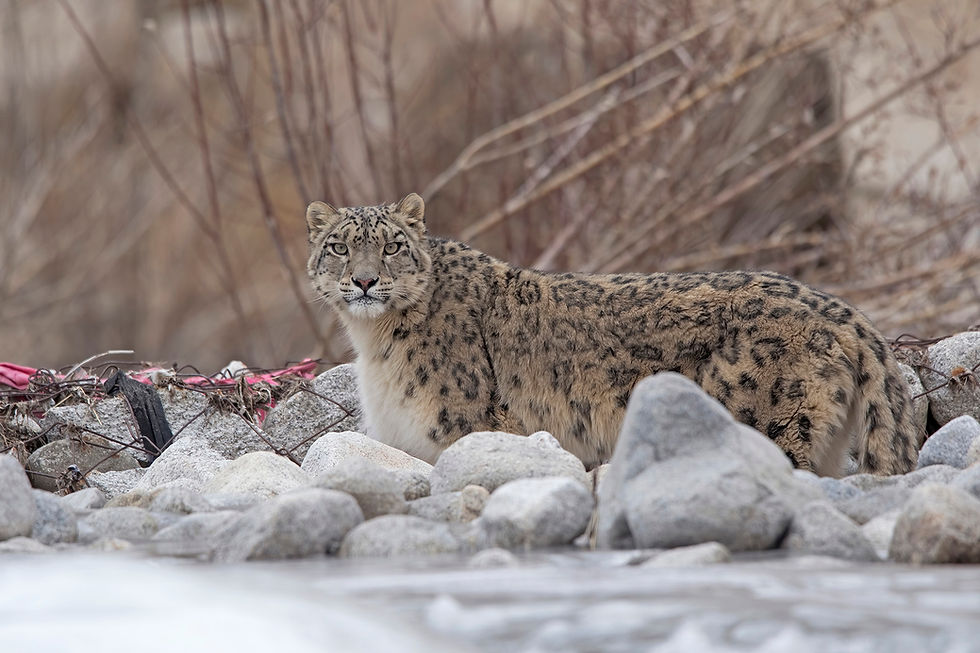
We watched her settle on a rock. Her pupils still dilated. We had never seen any creature gaze in such a way. She was recovering from the excitement of the moment. (for the lack of a better word). We clicked a few images and then just watched her. How often do we get to be this close to a snow leopard with just a natural barrier of sorts separating us. I even remember thinking that I was (geologically) standing in Asia and watching a snow leopard across in India, except she was just a few meters away.
She was absolutely gorgeous. Her eyes recovered slowly and she decided to snooze in front of us. The blue waters of the Indus and the chunks of ice that the river brought was the only movement in our frame. We couldn’t ask for anything more.
But she was still there…and we had plenty of time. The story hadn’t finished yet.

Something caught her attention. We had no idea what it was but it was surely behind us- across the river. She watched the area for a while, yawned, stretched and then got up. She started to descend towards the pebbles on the riverside, stopping every few minutes to look at that spot again. Had she found another herd of bharal? For a snow leopard to hunt with a genuine chance of success, they usually have to get to higher ground than the prey and chase them down. This is what I had seen and heard about over the years. Was she trying to get above them? In that case, was she going to cross the river to our side?
As these thoughts went through my head, she was already walking among the riverine stones. She had crossed one of the breakaway flows of the main river. I couldn’t believe my eyes! I was not just having my first close encounter with a snow leopard, but she was walking among stones with the Indus River flowing on either side of her. With my naked eye I could see every strand of fur on her body, the colour of her pupil, her twitching ears and muzzle, the way her body expanded as she breathed in the thin air – It was as if I was seeing a snow leopard for the first time ‘again’. In that moment she had to be the most beautiful thing I had ever seen.
The snow leopard stood there in front of us for what seemed like an eternity. She still had a major hurdle to cross (literally) - the flow of the Indus River. This was not something she could jump across. Even at the narrowest of stretches the river was still quite wide. What would she do?

She walked along the banks a while longer, us following on the other side keeping a safe distance so as not to spook her.
One thing to look back upon here is the fact that, in this steep Indus gorge minimal sunlight reaches the valley floor. This means parts of the river tend to freeze, especially where the flow is slower, even as early in the winter as November. This was exactly what she was looking for. And after a short search, she had found what seemed like the perfect spot.
She tested the strength of the ice for a few seconds, looked around, briefly glanced in our direction, and then walked.
The walk we had been waiting for! A snow leopard walking on the blue waters of the Indus!
Whether it was our low angle or the play of light, even though she was walking on frozen ice, for our eyes it looked as if she was walking on water. She walked the stretch of river as if she had done it many times before.
She crossed the entire stretch in a few seconds, what felt like a few hours of natural history brilliance for us. My shutter was going crazy through the entire ‘river crossing’ with irritating blank spaces where the memory card was buffering. I had no idea how the images had turned out but I knew I had enough there.
If the start was to be a distant blur on a ridge six years ago, I had surely reached the end.
I must add here that a vehicle that was driving by spotted her by the road and occupants stopped to click images with their phones (can’t blame them I guess). She turned around immediately and walked back towards the river, crossed over, went back up the gorge and settled on a rock halfway up. She might attempt the crossing later that night again. Maybe that’s when she should be doing this. We’ll never know!
For my part, I was finally there at the right spot. I had my perfect moment that surpassed my wildest imagination. And How!!!
I couldn’t wait to tell Norbu about it!


Comments