
Satpura - The Monsoon ‘’Off Season’’


It was the peak of the monsoons in Central India. The rains were relentless. Seasonal streams were overflowing their banks and the paths and roads turned into mini rivers. Dampness was everywhere, including our hair, clothes, bed spreads and shoes. The power ran out and along with that our laptops became useless. There was no mobile network in Satpura in those days. David and I were tasked with an ‘off season’ maintenance job at our lodge so we had to stay back despite the park being shut during this time of year. It wasn’t a tough task but it meant living for weeks among this constant downpour.
One evening, David suggested we go for a walk. Looking for frogs. This was my first season in the jungle and I sure was new to this world. A walk with ‘frog man’ David, rummaging through leaf litter, crawling through marshes and locating the hidden amphibian using their deceptive croaks sounded exciting to me. We were out soon, rubber slippers, ponchos and umbrellas with our cameras dangling precariously under the mercy of the rains. We met the usual suspects- bull frogs, balloon frogs, painted frogs, narrow-mouthed frogs, burrowing frogs and of course, cricket frogs (which we gave up trying to identify after the first few individuals) and hundreds of toads. But in all this frog orchestra, David heard a call that didn’t sound familiar to him. I honestly thought it was a cricket but was quickly proven wrong when the source of the call was found. It was a tiny toad calling from tall grasses among rainwater puddles. David thought it was something ‘new to science’- the first time I heard that term. High fives were exchanged, pictures were taken, and cameras were ruined. It took us a week to get the images out to the scientists who confirmed that we were looking at a Ferguson’s toad subspecies Duttaphrynus scaber sinhagad that was described by a group of scientists south of us just a week before. Davidensis, Suryaensis or Satpurensis had to wait.
But what this exciting find (late find) did for us was to start a chain reaction of walks for the next few weeks. Day in and day out we were waist deep in bogs, crawling through slush, climbing trees and all the while, documenting, taking pictures and notes. We came across a brilliant array of creatures and were learning so much in this so called ‘off season’ of the Central India jungle. One of the most memorable evenings was spent watching a snail laying eggs through its translucent body on a rock surface. Who would’ve thought!!!
We even went up to Panchmarhi for a few days (every month) to slip and slide through those hill forests looking for geckos, snakes, frogs and orchids. This area was always a spot of curiosity thanks to the presence of black-crested bulbuls and Malabar whistling thrushes, birds known from two opposite corners of our country. What else lies hidden away in this area?
This was my first year at Satpura. And till today, I am glad my first base was Satpura and not anywhere else. This laid the foundation of the work we would do in the years that followed. I would’ve been a different person had I started my naturalist life in a popular tiger park as opposed to one where we saw tigers only for Diwali and Holi (this really happened in 2012 and 13).
I spent a good five years in this park as David’s wingman and in that time, through our walks, canoe trips and monsoon explorations, we had experienced some precious moments in the wild and had come across some real jewels from the ‘’Ghane Jangals’’ of the Satpura hills.

Satpura Leopard Gecko
We finally did manage to find a Satpurensis from these forests. This was a beautiful leopard gecko, one of the oldest gecko lineages in India that David had photographed on his drive down from Dhoopgarh peak. Collaborating with scientists from Bangalore and some local guides in the region, we managed to understand more about this large rock/cave dwelling lizard and figured out that it was something new as the markings obviously did not match with the four or five other leopard geckos described from Indian limits. Thanks to the support from the forest department, we, along with the team of scientists, welcomed Eublepharis satpurensis or the Satpura Leopard Gecko, to the world in 2014.
During this expedition, led by Zeeshan Mirza, we also managed to find and describe, thanks to the keen eye and skill of the scientists, Hemidactylus chipkali a rock dwelling gecko, Hemidactylus gleadowii a ground gecko, Scorpiops pachmarhicus a species of scorpion that dwelled in crescent shaped burrows in mud walls and a trapdoor spider that lived right next to us on a dry stream bed behind its hidden door (which we obviously had no clue about). Such was the scope of learning in the time we spent in this park. The freedom to explore on foot, to slow down the pace of travel and to ask questions and find answers, we were surely in the right place to try and be real naturalists.
Elliot’s Shieldtail
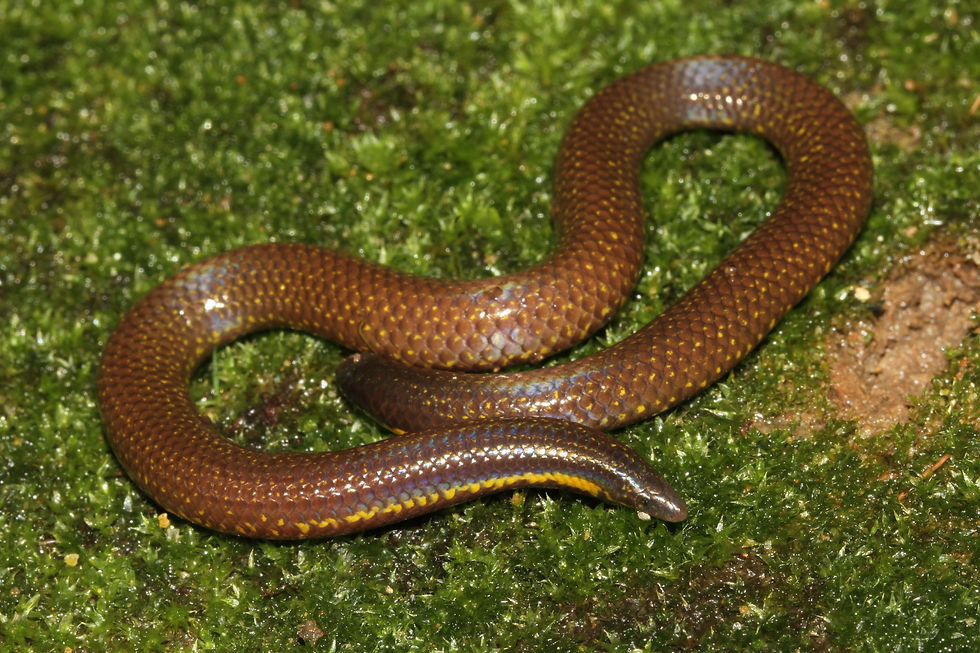
Shieldtail snakes were always well known from the Western Ghats. There are over 50 described species of these subterranean snakes from that region. Only during heavy monsoon showers, when their underground tunnels clog up, do these snakes emerge on the surface. The ‘Satpura Hypothesis’, a published paper that we came across, spoke about the Satpuras being an extension of the Western Ghats and a bridge to the forests of eastern India. There was proof of this in the kind of plants we saw, some butterflies, dragonflies and even some of the birds. I’m sure there are more examples but these were groups that we were familiar with. We had even heard about people seeing dracos or the flying lizards and painted bush quails in the Satpura hills, more possible examples of the ‘bridge’ with the Western Ghats, but we hadn’t seen these for ourselves.
We came across our first shieldtail in the upper reaches of the Satpuras. It was flattened on the road under the tire of a speeding vehicle. There was no mistaking that it was indeed a shieldtail. Rummaging through literature, we realized that there was one widespread species, the Elliot’s shieldtail, that was recorded in the Satpura hills. This was a beautiful bluish black snake with yellow speckling, yellow blotched undersides and a characteristic flattened hard tail with bright yellow markings surrounding it. We decided to look for it during the monsoons and found this snake in multiple locations within the Satpuras. All moist forest patches with perennial water and wet leaf litter. The exact identification of this snake is still a mystery and one that waits for scientific clarity, but for now, we had found the Elliot’s shieldtail in the Satpura hills (and my first ever shieldtail).
Panchmarhi Dark Evening Brown
Dark evening brown butterflies were well known from the Western Ghats. But seeing one in the Forest Department’s Panarpani Butterfly Garden in the Satpura Hills was a surprise. And there wasn’t just one. We found at least a few hundred. And later, one even popped up at the park gate at Madhai. David was quick to identify it and get some images. After another deep dive into the books and conversations with our Lepidopterist friends, we came across a long forgotten butterfly subspecies, the Panchmarhi Evening Brown or the Panchmarhi Dark Evening Brown – the only endemic butterfly (even though only a subspecies) to Central India and the Satpuras. Once we heard of this, we decided to spend more time in Panarpani expecting more such creatures to pop up. And we were not disappointed. We encountered a wide range of butterflies and dragonflies that we had no idea existed in these hills. There were members from the Western Ghats, eastern Himalaya and some that did not match any thus far described. This was a whole new world that was suddenly opened up to us thanks to the presence of the Panchmarhi Dark Evening Brown. Even today, surveys by naturalists are leading into interesting new surprises from these hills, especially the Panarpani area.
The Fragrant Ceropigea

The summers and monsoons in the Satpura hills are a botanist’s paradise, and a nightmare for us. We admit that botany is something we struggle with. But with the first rains, the flowering starts, making life a lot easier for us. We usually take this opportunity to go into the hills in search of ground orchids, tree orchids, balsams, birthworts and one group more so among others, insectivorous plants. We had seen sticky sundew plants Drocera sp. shining bright among the wet rocks and streamside mud in this area. On one walk with our guests, we came across a rare flytrap, a lantern flower vine that we did not recognize. These flowers are known for their ability to trap flying insects inside their narrow tubes and then using them (now covered with pollen) to pollinate nearby flowers. This one that we came across was identified by ace botanist Aparna Watve as Ceropegia odorata or the fragrant ceropegia, the only member of the group with a strong fragrance and a rare plant with just a few records in history. This is possibly the biggest floral highlight of our time there, though many more remain unidentified and we continue to struggle with plants big and small wherever we go.
In our five years between Madhai and Panchmarhi, and our travels in that time, we managed to expand our knowledge and widen our perspectives about understanding and exploring a wilderness. We focused on the taxa groups we knew and understood well (lot of time was put in to try and understand the bats and rodents of the region too). Satpura was a paradise for bird enthusiasts like us popping up regular surprises like the gray phalarope, golden-headed cisticola, long-legged buzzard, Amur falcon, rufous-fronted prinia and many others. We had kept a log of all our encounters in Satpura and the central Indian landscape as a whole.
At this very time, during our exploration highs, we came across a beautiful book, ‘A Photographic Field Guide to the Wildlife of Southern Africa’. A simple beautiful book that laid bare and simple, the biodiversity of the region there. This was our inspiration to pen our first book, ‘Photographic Field Guide – Wildlife of Central India’, a comprehensive guide to the mammals, birds, butterflies, dragonflies, reptiles and amphibians of the region. And we wrote it while in Satpura. A book that wouldn’t have been possible if not for this beautiful wilderness and the times we spent on ‘maintenance duty’ during the monsoons.



Comments